Sleight of Hand
The Journal of Modern Craft, June 2021
Reviewed by Anna Helgeson

Before I can stop myself, I am dancing to the hypnotic beat flooding the gallery, and a nearly forgotten (Thanks, 2020) feeling fills my body: joy. The music is by Joshua Sigman, made to accompany Natalia Arbelaez and Chris Stone’s video El Dorado Ritual (Figure 1). The video features Arbelaez covered in gold body paint, donning a gold lamé bikini and a gold, moon-like ceramic mask complete with toothy scowl and swollen little eyes, dancing while floating through a star-filled night sky. The figure pulses and multiplies, changing color as various psychedelic drawings float through space. The effect is funny, strange, and captivating. And, like most of the work in Sleight of Hand, the seduction of the video is a means to an end. Arbelaez, a Colombian American artist whose work is a mash-up of reinterpreted rituals from her ancestral homeland and club life in her current hometown of Miami, uses humor and playfulness to draw viewers close. She engages us in a conversation about appropriation, the racist history of American ceramics, and colonialism.
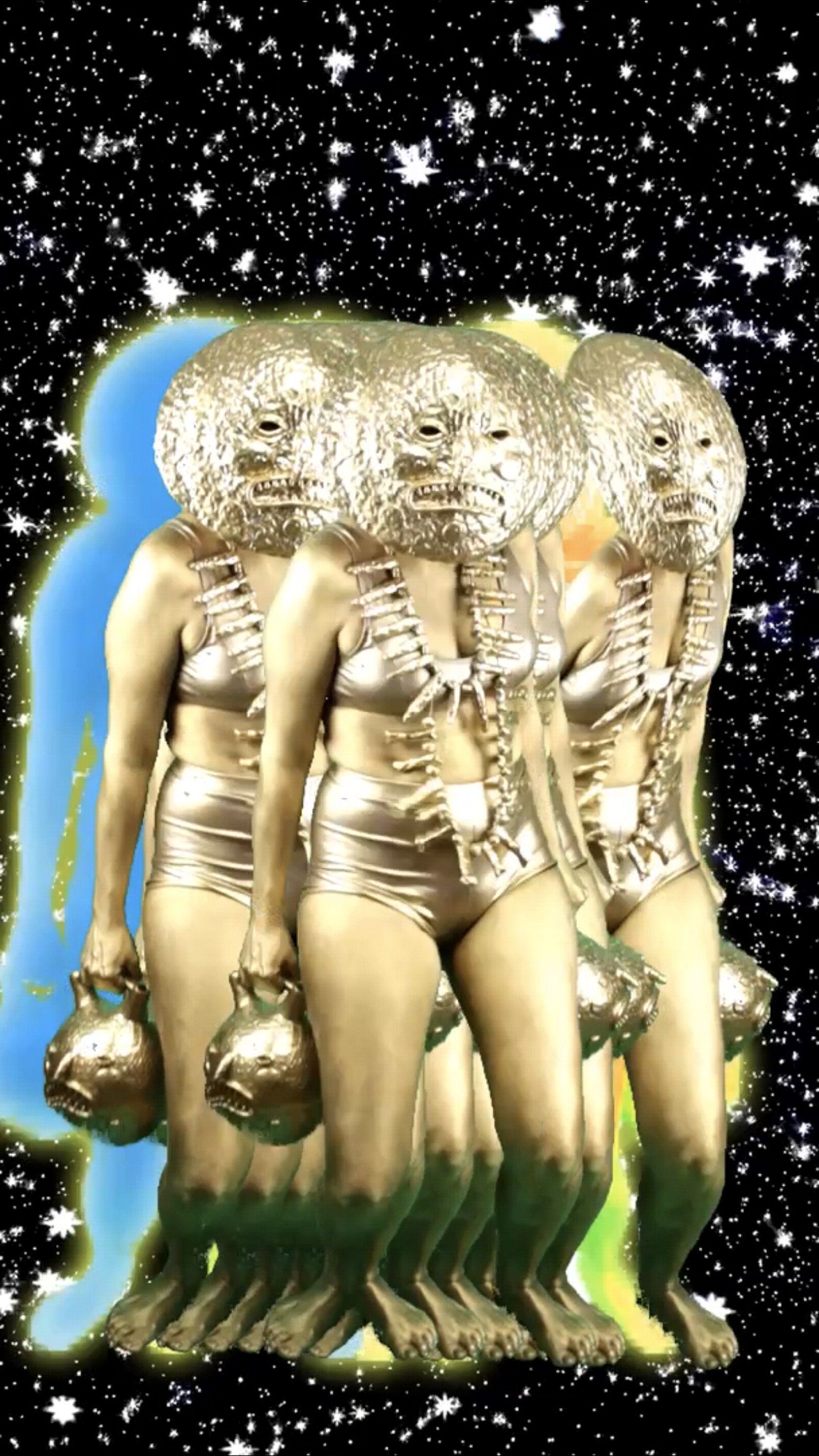
Natalia Arbelaez and Chris Stone with music by Joshua Sigman, El Dorado Ritual, 2019
Digital video, 6 min 21 sec. Photo courtesy of the artist.
Humor is a useful tool. Unlike the tools generally associated with ceramics (a potter’s wheel, a loop tool), the results are less predictable. But when it comes to speaking truth to power, cultivating empathy, and seducing viewers into a deeper understanding, there are few tools more powerful than humor. This is something curator and 2020 Center for Craft Curatorial Fellow, Angelik Vizcarrondo-Laboy, knows well. Her extensive research in the uses of humor and cuteness serve as the foundation of this small but impressive exhibition featuring eleven works by six ceramic artists of color, ostensibly carrying on the legacy of Funk or Nut Art.
“Funk” entered mainstream art-world consciousness with the exhibition Funk curated by Peter Selz in 1967 for the Berkeley Art Museum (now the Berkeley Art Museum and Pacific Film Archive, or BAMPFA). Though the exhibition ran for little over a month, it tapped into a Beat/Jazz aesthetic popular in the Bay Area. It also tapped into an underexamined abject fear and desire white people felt towards people of color, an attitude evident in this short passage from the 1967 catalog:
“The term itself was borrowed from jazz: since the twenties Funk was jargon for the unsophisticated deep-down New Orleans blues played by the marching bands, the blues which give you that happy/sad feeling.
Funk art is hot rather than cool; it is committed rather than disengaged; it is bizarre rather than formal; it is sensuous; and frequently it is quite ugly and ungainly.”
New Orleans blues and jazz, unsophisticated, hot, bizarre, sensuous, and ugly – these are all code words for Black. In these few sentences Seltz uses what Toni Morrison refers to as “race talk” to simultaneously reinforce his whiteness while signaling his bravery for engaging with people of color. This signaling is still a common way to “innocently” define the borders of whiteness while avoiding the overt appearance of racism, a method Robin DiAngelo refers to as aversive racism. Footnote 2
Given this heavy history, it is significant that all six artists featured in Sleight of Hand are BIPOC engaging with the irreverent style and humor of Funk, while reclaiming its powerful roots for themselves.
Opting for the appearance of literal sweetness to entice viewers close, artist Yvette Mayorga layers her canvas with frosting like globs of paint and clay calling to mind the best childhood sugar rushes. But with the rush comes the inevitable sugar crash. Upon closer inspection, you see that the canvas is a reinterpretation of a Century Vase. Century Vases were created to celebrate America’s 100th birthday at the 1876 Centennial Exhibition in Philadelphia. Most featured a white glowing profile of George Washington floating on a dark blue background, bison-head handles, and detailed vignettes of the nation’s colonial past in sculptural relief around the perimeter. In contrast, the central image in Mayorga’s Vase of the Century features small figures scaling a white fence against a blue-sky background as a way to recognize the countless Lantix migrants risking their lives for entry into the United States each year. Instead of historical vignettes of “American life,” Mayorga depicts piles of cheap plastic flip phones, soda bottles, and trinkets created specifically for disposability.
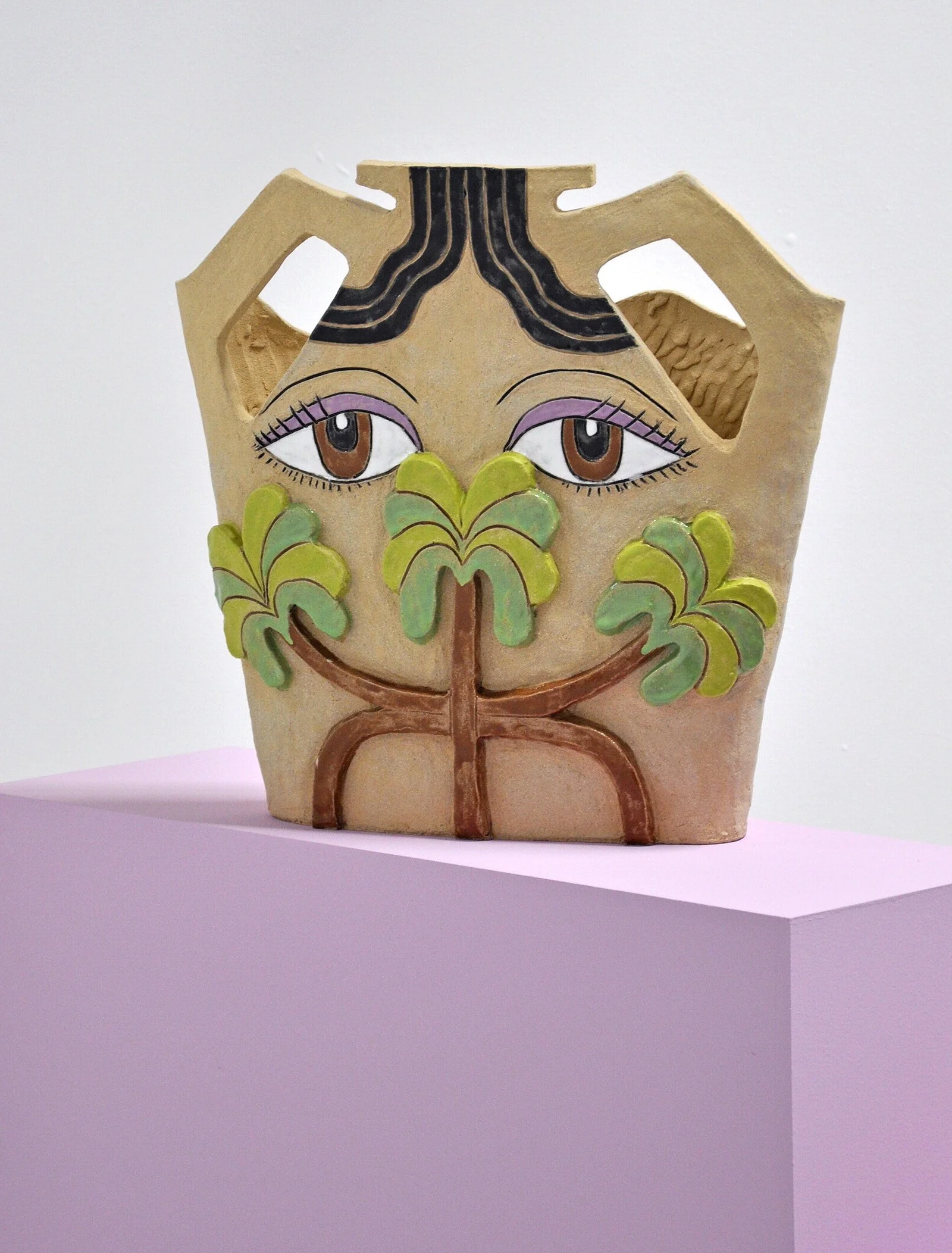
Maryam Yousif, Puabi Palms Pot, 2019
Stoneware and glaze, 20 × 5.5 × 19.5 inches. Photo courtesy of Guerrero Gallery.
One of the most subtle yet complex works in the exhibition is Iraqi American Maryam Yousif’s Puabi Palms Pot, part of a larger series created by Yousif in reference to an ancient Sumerian (modern-day Iraq) queen, Puabi of Ur, whose tomb was discovered in the 1920s (Figure 2). The excavation of her tomb revealed abundant riches and contained evidence indicating she ruled alone, without the encumbrance of a king. The work from this series in Sleight of Hand appears to be an anthropomorphized handbag, with large eyes peering over stylized palm trees suggesting a mouth and nose. The face is less portrait than reference to both an ancient queen and pop-star royalty (Kim Kardashian comes to mind), whose lavish lifestyle and abundant riches will likely follow them to the grave. The piece serves as a pointed reminder that Iraq has been and is still a place of glamour, riches, and conspicuous consumption, not just the war-torn wasteland most Americans have been trained to see.
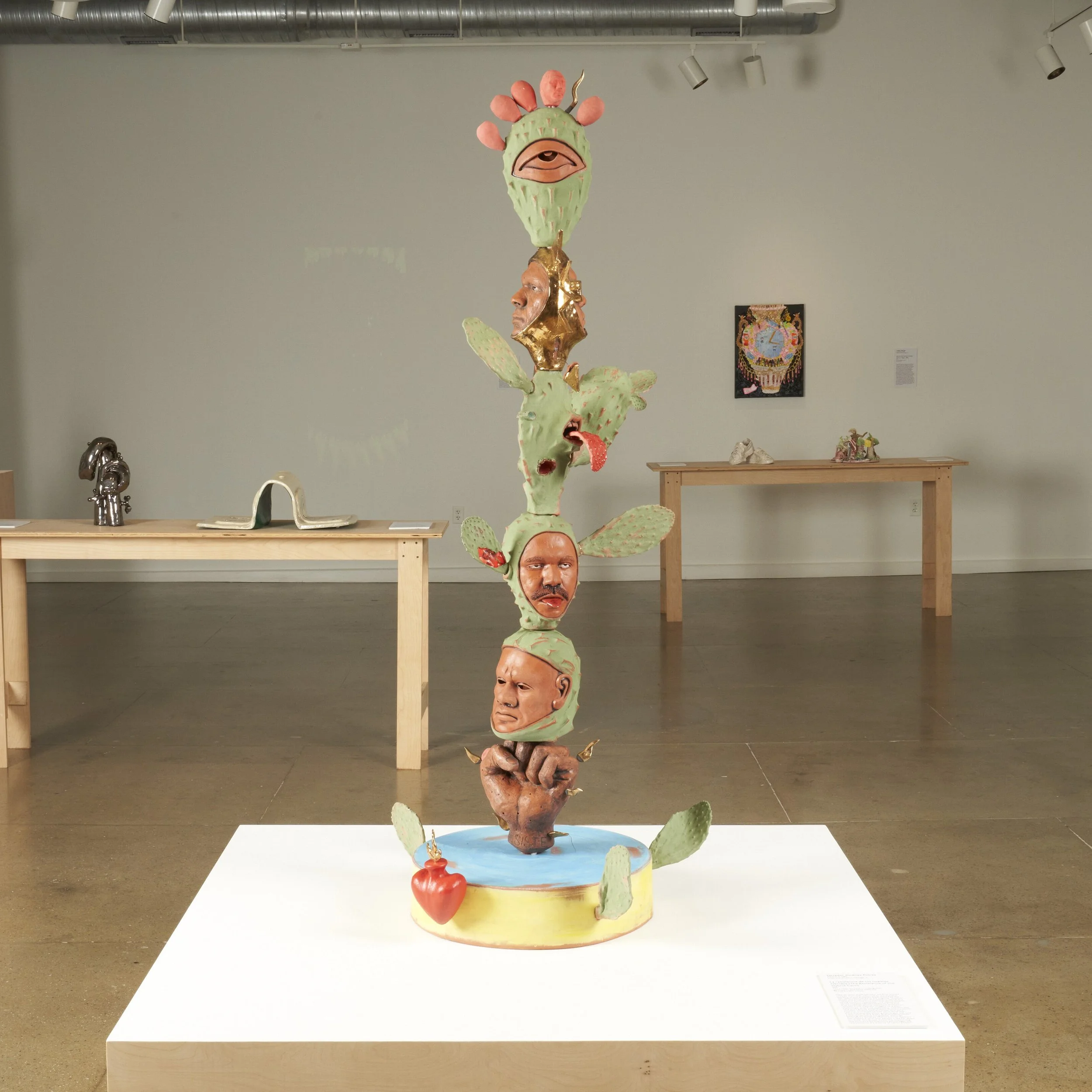
Salvador Jiménez-Flores, The Resistance of the Hybrid Cacti, 2017
Earthenware, porcelain, underglazes, gold luster, and terra cotta slip, 70 × 29.5 × 29.5 inches. Photo by Black Box Photography.
The work that references the Funk movement most directly in Sleight of Hand is La resistencia de los nopales híbridos (The Resistance of the Hybrid Cacti), by Salvador Jiménez-Flores (Figure 3). Sitting in the center of the gallery, this large totem-like cactus sculpture is unavoidable. Mint green cactus skin encases a stack of heads to form the totem. Each head is a playful take on a self-portrait including one that directly references Funk’s poster-child, Robert Arneson with a mustached character irreverently sticking out his tongue, the gesture of choice for many of Arneson’s ceramic heads and paintings. Another head references Huitzilopochtli, the Aztec sun and war god complete with reflective sunglasses. The entire totem is supported by a large Brown fist, suggesting a reclaiming of Brown power, especially as it relates to the history of ceramics. This history long proceeds Arneson, and indeed Columbus’s “discovery” of America.
“Funk” first appeared in ceramic circles with Funk John in 1963, a hand-sculpted toilet created by Robert Arneson as a kind of metaphoric middle finger to an art world that refused to take ceramics in general, and Arneson specifically, seriously. Motivated by this sense of rejection, Arneson continued to make bold, irreverent work for the duration of his career, including the problematic work in “The Black Series,” 1988–1990, ostensibly intended to address racism and racist images head-on by painting portraits of Black men accused of crimes and widely circulated within mainstream media outlets. The series also includes Arneson’s artistic reaction to allegations of racial insensitivity from Mike Henderson, a Black colleague at UC Davis. In the mixed-media piece Arneson is in black face, wearing a hat that reads Yas-Suh, the very expression Henderson requested Arneson stop using, an expression that Arneson would frequently use to “playfully” act as a slave responding to a slave master. Footnote 3
Using glossy glazes and formally clean aesthetics, ceramicist Woody De Othello creates objects that reflect the exhaustion caused by engaging with such histories and their contemporary echoes. Out Let which appears to be an oversized wall outlet, enlarged to 21 inches long by 14 inches wide, slinks wearily across the table, pulling its limp body away, perhaps warped from overuse to, as Vizcarrondo-Laboy puts it, “…seek respite from the burden of giving its power to other objects, a metaphor for the labor of Black bodies, which is often taken for granted and abused.” Footnote 4
The humor employed by the artists in Sleight of Hand is more nuanced, less childish, and more powerful than that of Arneson and the group of loosely associated Funk artists of the 1960s. While there are convincing arguments urging us to decenter or eliminate the narrow colonial, American Studio Craft canon that highlight problematic exhibitions like Peter Seltz’s Funk, curator Vizcarrondo-Laboy makes a convincing argument to do just the opposite: to remember, look the past in the eye, and wink.
Notes
1 Peter Selz, “Notes on Funk,” in Funk (Berkeley: Berkeley Museum of Art, 1967), 3. Exhibition catalog.
2 Robin DiAngelo, White Fragility (Boston: Beacon Press, 2018), 43.
3 “Robert Arneson: The BLACK Series: Selected Works 1988-1990.” George Adams Gallery, https://www.georgeadamsgallery.com/ (accessed December 2, 2020).
4 Angelik Vizcarrondo-Laboy, “Second Act: A New Generation” in Sleight of Hand (Asheville: The Center for Craft, 2020), 25. Exhibition Catalog.
Helgeson, Anna. 2021. “Sleight of Hand.” The Journal of Modern Craft 14 (1): 87–92. doi:10.1080/17496772.2021.1896113.